How to find keyword search volumes — current scope
Provider concepts remain useful, but earlier instructions for BeKnow’s SEO, writing, image or AI-visibility screens no longer describe the current public product. Saving a provider key does not enable those retired workflows.

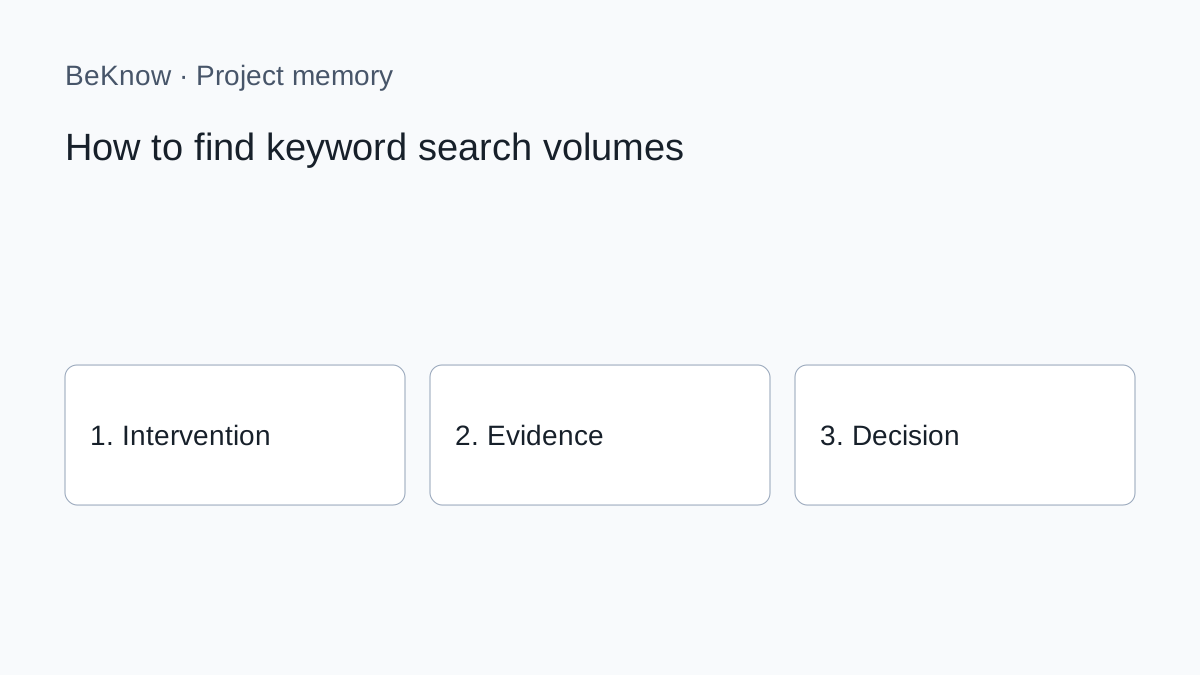
Provider concepts remain useful, but earlier instructions for BeKnow’s SEO, writing, image or AI-visibility screens no longer describe the current public product. Saving a provider key does not enable those retired workflows.
How to apply the method today
1. Define one question and the page, product or project it concerns. Record the source and date of each observation. A provider response is evidence to interpret, not an approved business decision.
2. Carry out the specialist research or content work in the external tool appropriate to the task. Check its current documentation, access requirements and costs. The availability of a provider API does not imply that every capability is integrated in BeKnow.
3. In BeKnow, record the intervention, its hypothesis and the relevant asset. Add the before and after where available. Identify missing evidence rather than filling the gap with an estimate.
4. For supported WordPress and Search Console work, inspect the available verification and checkpoint evidence. For other sources, the initial imports remain separate from automated intervention outcomes.
5. Record whether to continue, stop or investigate, why, and the next step. A review date is a recorded reminder, not a fully managed assignment or notification workflow.
The underlying method
A keyword idea can sound perfect and still have little measurable demand in the market you serve. Search volume helps test that assumption, but it is not a traffic forecast and it should never decide the editorial plan by itself.
What search volume actually means
- volume indicates approximate demand;
- monthly history reveals seasonality or change;
- CPC can hint at advertiser value, not organic conversion;
- competition refers to paid search, not SEO difficulty.
Similar keyword variants may receive combined values, and some terms return no data. Treat a null or low value as evidence with limitations, not proof that no user ever searches the topic.
Create or use a DataForSEO account and retrieve the API login and API password from its API access area. They are not necessarily the same credentials used to sign in to the website.
Choose location before reading the number
“CRM software” does not have one universal volume. A result for the United States in English is not interchangeable with Italy in Italian or Spain in Spanish. Set the market that matches the intended reader and preserve it beside the result.
For a multilingual content unit, validate the natural local query in each active language. Do not translate the English keyword literally and reuse its number. People may describe the same task differently across markets.
Build a small candidate set
- Search Console queries already generating impressions;
- language used on product and service pages;
- recurring sales or support questions;
- gaps found in the published-content inventory;
- non-branded questions used in AI visibility monitoring.
Remove candidates that duplicate an existing page’s intent before paying for enrichment. The guide on updating versus creating an article prevents volume from producing unnecessary URLs.
Request and interpret the evidence
Send a focused batch for one market and review volume together with monthly history. A high annual average can hide a short seasonal peak. A lower but stable query may be more useful for an evergreen product.
- relevance to the offer;
- fit with the reader’s intent;
- evidence that the site can produce a better answer;
- current visibility in Search Console;
- effort and internal-link support.
Search Console and volume solve different problems
Search Console shows the queries for which your property already appeared in Google Search. DataForSEO adds external market estimates, including queries for which the site may have no visibility yet.
If Search Console shows impressions but volume is modest, the query can still be a strong quick win because the site already has relevance. If external volume is high but the site has no suitable offer or expertise, the topic may remain a poor choice.
- Read the current content inventory.
- Collect candidate intents from first-party evidence.
- Remove overlaps.
- Set location and local query language.
- Request DataForSEO enrichment for the remaining set.
- Review volume, history and commercial relevance.
- Save approved opportunities in the editorial plan.
- Record source, market and retrieval date.
Is search volume exact?
No. It is an approximate average derived from provider data and targeting settings.
Does high volume mean easy SEO traffic?
No. Volume does not describe organic difficulty, intent fit or expected click-through rate.
Why can similar keywords show the same number?
Google Ads data can group close variants. Test natural formulations separately and interpret clusters, not false precision.
No. The provider connection is required for those external numbers.
Use volume to challenge assumptions
Search volume is valuable when it filters and contextualises ideas, not when it replaces strategy. Validate the local query, preserve the source and combine the number with first-party performance and business relevance.
What BeKnow keeps
Keep interventions, hypotheses, assets, observations and decisions in a searchable workspace. Record what is known and what still needs checking.
Preserve the reason for a choice and the next step alongside the intervention. Review dates are recorded; a complete assignment and review inbox is not available yet.
Connections and limits
Shopify, WooCommerce, Magento, GA4, Google Ads, Meta Ads and HubSpot have initial read connectors. Imports are started manually and their data can be inspected or read through MCP. Coverage and setup differ by provider; automatic links to intervention outcomes are still being developed.
A change in performance after an intervention does not prove that the intervention caused it. Cross-platform attribution and a complete analytics dashboard are not available today.
AI and costs
Project memory and data imports do not require an AI model key. A compatible external AI client may have its own costs. BYOK applies only to available functions that actually call an external provider.
Free access during the current adoption phase. No BeKnow credit wallet.
Next step
Start with one project, one documented change and the evidence needed to review it. Source connections.
About the author
Marco Salvo is the founder of BeKnow. With more than 20 years in SEO, he created BeKnow to connect project changes with real-world results and turn that history into knowledge people and AI can use.
Record your first intervention
Start with one project, one documented change and the evidence needed to review it.
Create a free workspace