How to analyse a SERP and its competitors — current scope
Provider concepts remain useful, but earlier instructions for BeKnow’s SEO, writing, image or AI-visibility screens no longer describe the current public product. Saving a provider key does not enable those retired workflows.

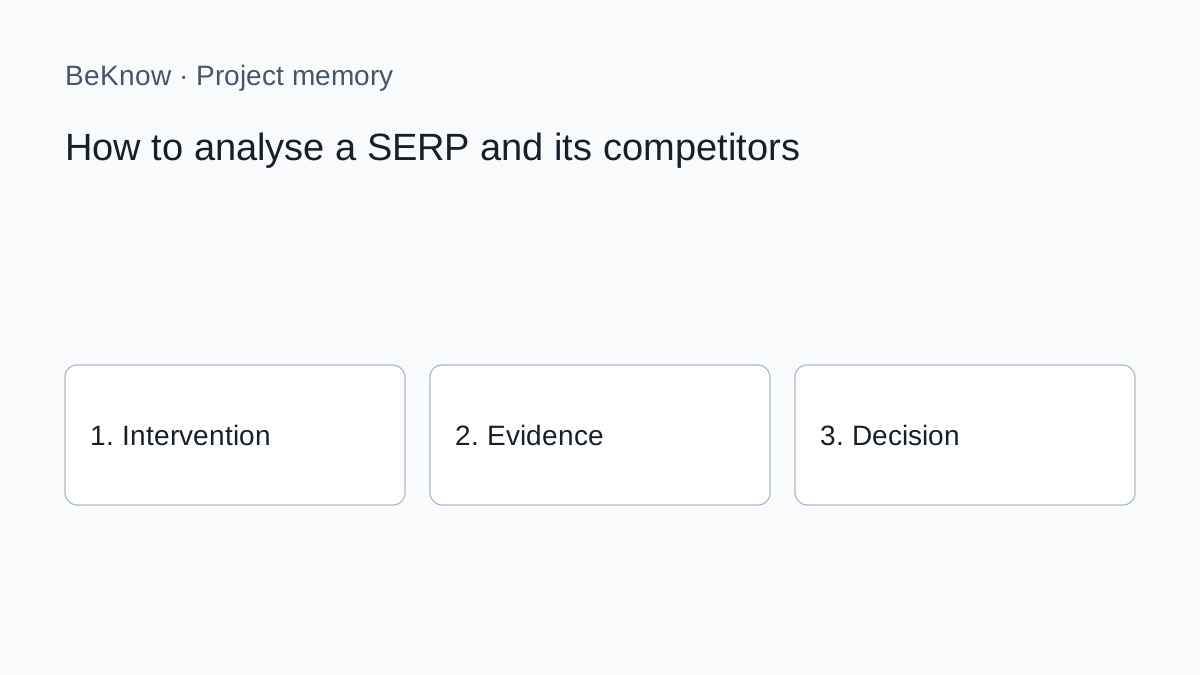
Provider concepts remain useful, but earlier instructions for BeKnow’s SEO, writing, image or AI-visibility screens no longer describe the current public product. Saving a provider key does not enable those retired workflows.
How to apply the method today
1. Define one question and the page, product or project it concerns. Record the source and date of each observation. A provider response is evidence to interpret, not an approved business decision.
2. Carry out the specialist research or content work in the external tool appropriate to the task. Check its current documentation, access requirements and costs. The availability of a provider API does not imply that every capability is integrated in BeKnow.
3. In BeKnow, record the intervention, its hypothesis and the relevant asset. Add the before and after where available. Identify missing evidence rather than filling the gap with an estimate.
4. For supported WordPress and Search Console work, inspect the available verification and checkpoint evidence. For other sources, the initial imports remain separate from automated intervention outcomes.
5. Record whether to continue, stop or investigate, why, and the next step. A review date is a recorded reminder, not a fully managed assignment or notification workflow.
The underlying method
A competitor SERP analysis is not a list of domains to copy. It is a structured look at the results Google selects for a specific query, location, language, device and moment. The aim is to understand the dominant intent, the page formats that satisfy it and whether your site has a relevant gap.
Define the SERP before comparing it
The same keyword can produce different results by country, language, device and time. Record these parameters with every analysis. DataForSEO’s SERP API is designed to return results for the chosen search engine and location while excluding personal search history and other user-specific personalisation.
That makes the observation comparable, not universal. Do not say “this is the ranking everywhere”. Say which market and device were checked and when.
Choose competitors from the result, not only from memory
Commercial competitors and search competitors are not always the same. A software company may compete in the SERP with review sites, documentation, publishers, forums or Google-owned features. Those results reveal what kind of answer the query currently rewards.
- ranking domain and URL;
- result and page type;
- title and apparent promise;
- your domain’s presence and preferred page;
- repeated domains across the keyword cluster;
- significant SERP features.
Classify page type before judging content depth
Look for patterns: product pages, category pages, definitions, tutorials, comparisons, tools, documentation, videos or community discussions. If the first page is dominated by hands-on tools, another generic explainer may not match the task. If it is dominated by definitions, a sales page may be premature.
Do not infer quality from word count. A concise official reference can outperform a long article because it is the right source. The important comparison is which questions, evidence and format help the reader complete the job.
Distinguish a keyword gap from a content gap
- the query is relevant to your offer;
- it represents a distinct user intent;
- an existing page could be updated;
- local search volume or first-party evidence supports priority;
- the site can provide a credible answer.
When Firecrawl adds value
DataForSEO shows the result set and associated SERP information. It does not require Firecrawl. Connect Firecrawl only when you need to retrieve and compare the actual content of selected pages: headings, claims, evidence, entities or missing subtopics.
Do not copy a competitor’s structure or wording. Use observations to identify the reader’s unresolved task and create original, sourced material.
Turn the analysis into an editorial brief
- query cluster and market parameters;
- dominant intent and result types;
- recurring competitors;
- whether your preferred URL appears;
- verified gap or overlap;
- recommended action and supporting evidence;
- internal pages that should link to the destination;
- a date for rechecking the SERP.
Compare traditional SERPs and AI citations carefully
Preserve the method for each observation. Search results need engine, location, language, device and date. AI visibility needs model, prompt, language, date and source status.
Do I need to analyse every first-page result?
No. Start with the results and repeated patterns needed to establish intent and competition. Expand only when the decision remains unclear.
Is a competitor keyword automatically a content opportunity?
No. It must be relevant, distinct and supportable by your site.
Does Firecrawl replace DataForSEO?
No. DataForSEO retrieves SERP evidence; Firecrawl can read selected pages in depth.
Can a SERP change after the analysis?
Yes. Save parameters and date, then recheck material decisions.
Study the result, then choose the smallest useful action
The best SERP analysis does not produce the longest competitor spreadsheet. It explains what users appear to need, whether your site already has the right destination and what evidence supports the next action.
What BeKnow keeps
Keep interventions, hypotheses, assets, observations and decisions in a searchable workspace. Record what is known and what still needs checking.
Preserve the reason for a choice and the next step alongside the intervention. Review dates are recorded; a complete assignment and review inbox is not available yet.
Connections and limits
Shopify, WooCommerce, Magento, GA4, Google Ads, Meta Ads and HubSpot have initial read connectors. Imports are started manually and their data can be inspected or read through MCP. Coverage and setup differ by provider; automatic links to intervention outcomes are still being developed.
A change in performance after an intervention does not prove that the intervention caused it. Cross-platform attribution and a complete analytics dashboard are not available today.
AI and costs
Project memory and data imports do not require an AI model key. A compatible external AI client may have its own costs. BYOK applies only to available functions that actually call an external provider.
Free access during the current adoption phase. No BeKnow credit wallet.
Next step
Start with one project, one documented change and the evidence needed to review it. Source connections.
About the author
Marco Salvo is the founder of BeKnow. With more than 20 years in SEO, he created BeKnow to connect project changes with real-world results and turn that history into knowledge people and AI can use.
Record your first intervention
Start with one project, one documented change and the evidence needed to review it.
Create a free workspace